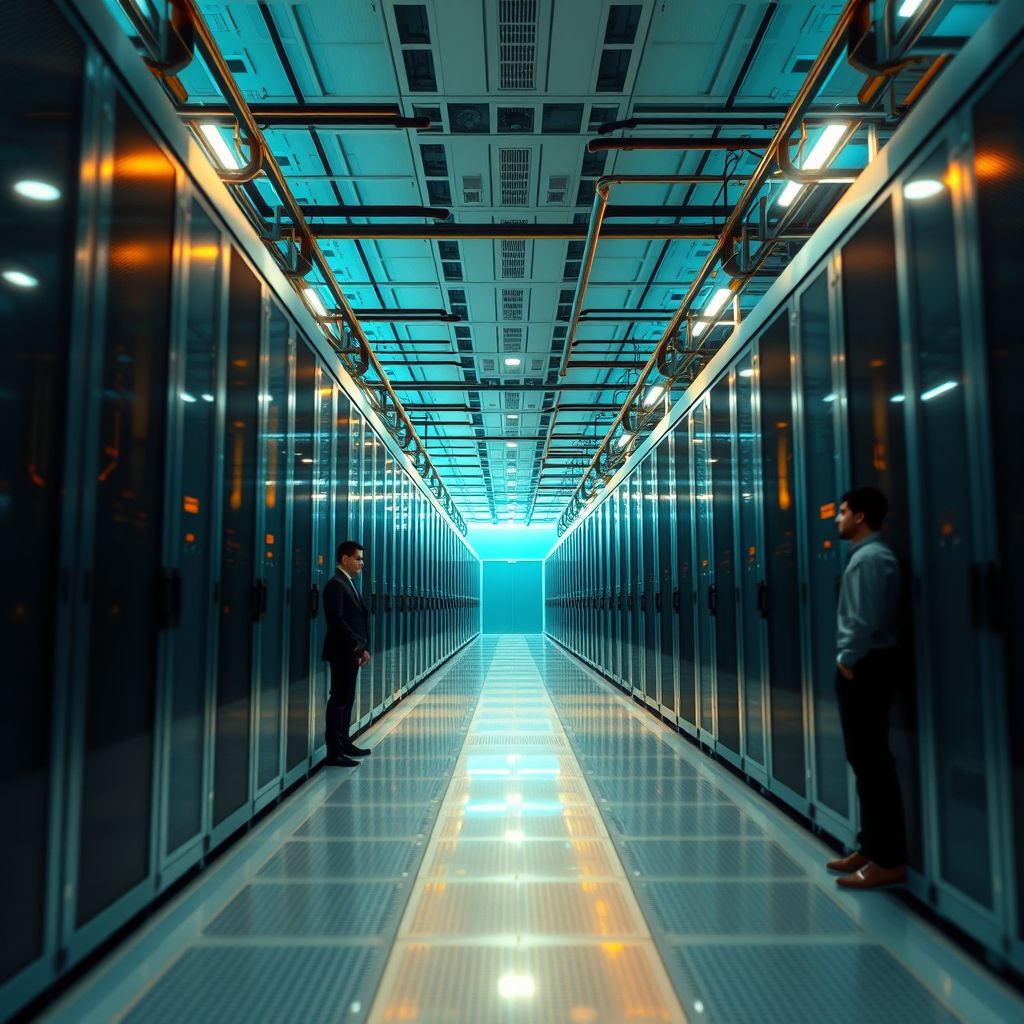
Why 800 VDC AI Data Centers from Khazna and Siemens Matter for Critical Infrastructure
Khazna and Siemens are piloting AI-optimized data centers using 800 VDC power distribution. For operators of critical infrastructure, this shift promises higher efficiency, reduced complexity, and new opportunities for edge AI, predictive maintenance, and resilient power design.
Introduction: A power shift for AI infrastructure
Khazna and Siemens have announced preparations for data centers designed specifically to support large-scale AI workloads using 800 VDC power distribution. This is more than a vendor headline: it signals a practical rethinking of data center electrical architecture tailored to modern AI hardware and the needs of critical infrastructure operators. For owners of utilities, transportation networks, industrial campuses, and public-sector control systems, the move toward higher-voltage DC power in AI-focused facilities brings potential gains in efficiency, resilience, and operational simplicity — but also raises engineering and monitoring requirements that must be addressed strategically.
What happened: 800 VDC meets AI data centers
Khazna, working with Siemens, is designing and deploying data center systems that provide 800 V direct current distribution to racks and accelerators optimized for AI processing. Traditional data centers typically distribute AC power and use multiple conversion stages to feed server components, often operating at 48 VDC distribution inside racks. By contrast, 800 VDC reduces the number of conversion steps, lowers I2R losses in cabling, and better matches the input requirements of modern GPUs and AI accelerators that are increasingly tolerant of higher-voltage DC supplies or employ onboard converters designed for such environments.
The collaboration focuses on integrating power electronics, uninterruptible power systems, switchgear, and monitoring platforms that can manage 800 VDC safely while enabling rapid deployment of dense AI hardware. Siemens contributes proven industrial power and protection systems and controls, while Khazna aligns the solution to data center and AI workload requirements.
Why this matters for critical infrastructure owners and operators
Critical infrastructure operators face three pressing challenges: rising compute demand for analytics and AI, the need for resilient power at distributed sites, and pressure to reduce operational cost and carbon footprint. Adopting 800 VDC AI data centers offers direct benefits on all three fronts.
First, efficiency. Higher-voltage DC reduces conversion stages and conductor losses, translating into lower power consumption for the same compute load. For infrastructure operators running energy-intensive AI tasks such as traffic optimization, fault detection, or grid analytics, cumulative savings in PUE and energy bills are substantial.
Second, resilience and modularity. DC distribution can simplify microgrid and battery integration. For substations, water treatment plants, rail control centers, or edge compute sites, 800 VDC makes it easier to pair battery energy storage systems (BESS) or renewable generation with compute loads without multiple AC-DC-AC conversions. That reduces failure points and accelerates switchover during outages.
Third, space and density. AI accelerators demand high power density. 800 VDC distribution supports higher power per rack with lower cabling mass, enabling more compact deployments at edge and centralized sites alike.
Operational caveats for owners and operators
Transitioning to 800 VDC is not plug-and-play. Operators must update safety protocols, retrain technicians, and revise procurement standards for switchgear, breakers, and PDUs rated for higher DC voltages. Protection coordination is different in DC systems; arc suppression, rapid disconnects, and monitoring for leakage currents become critical. Maintenance practices, spare parts inventories, and capacity planning models must also adapt.
How AI, Digital Twins, IoT, and Edge Technologies Fit In
Implementing 800 VDC AI data centers intersects with several digital technologies that critical infrastructure teams are already adopting. Digital twins and infrastructure monitoring become essential when managing novel electrical topologies with tight performance margins. A digital twin of the power distribution network — including 800 VDC buses, converters, batteries, and cooling infrastructure — lets engineers simulate fault scenarios, optimize protection settings, and plan maintenance windows with reduced operational risk.
Edge AI deployments benefit directly. Many critical systems require low-latency inference near the sensors: rail signaling, intelligent traffic control, industrial control loops, and real-time video analytics for public safety. Local AI clusters powered by 800 VDC can be smaller, denser, and more energy-efficient, enabling edge sites to host advanced models previously confined to centralized cloud centers.
IoT sensors and computer vision systems provide the telemetry needed to manage these environments. Real-time monitoring of bus voltages, thermal hotspots, vibration, and air flow enables predictive maintenance of power electronics and cooling systems. Edge AI can analyze that telemetry locally to predict component degradation and trigger safety actions before failures propagate.
Practical engineering and operational insights
For engineering teams planning 800 VDC AI facilities, these practical considerations are central:
- Protection and safety: Design redundant protection layers with DC-rated breakers, fast-acting fuses, and arc fault detection. Specify components to meet relevant DC electrical safety standards and perform full-system arc flash analysis for DC conditions.
- Thermal management: Higher rack densities push cooling requirements. Consider direct-to-chip cooling and monitor coolant conductivity and flow with IoT sensors to avoid contamination and ensure pump reliability.
- Battery and microgrid integration: Match inverter and BESS architectures to DC distribution to minimize conversions. Use power electronics that support bidirectional flows for grid services and resilience modes.
- Monitoring and digital twins: Deploy high-fidelity telemetry at converter, bus, rack, and PDU levels and model the system in a digital twin for what-if analysis and failure-mode simulation.
- Standards and interoperability: Use open protocols for telemetry (Power over Ethernet, Modbus, IEC 61850 where relevant) and ensure vendor-neutral interfaces for power electronics and management systems.
Future industry implications
Wider adoption of 800 VDC in AI data centers could accelerate several trends important to infrastructure owners. First, the economics of edge AI will improve, enabling more distributed intelligence across transport, utilities, and public facilities. Second, power systems will become more DC-centric, favoring architectures that natively support batteries and renewables and reducing dependency on synchronous grid services. Third, demand for specialized monitoring, digital twin platforms, and edge orchestration will increase as operators seek to run complex, safety-critical AI stacks reliably.
Regulators and standards bodies are likely to evolve DC safety and interoperability standards, and training programs for electrical technicians will expand to cover high-voltage DC maintenance and protection. Vendors that offer integrated solutions — combining DC power systems, thermal controls, monitoring, and digital twins — will be favored by risk-averse infrastructure operators.
Conclusion: A strategic opportunity with technical responsibilities
The Khazna and Siemens initiative to prepare AI data centers with 800 VDC distribution is a strategic signal to infrastructure owners: compute and power architectures are converging. For operators of critical infrastructure, the shift promises efficiency gains, improved resilience, and better alignment with battery-backed, renewable-powered operations — provided the transition is managed with rigorous engineering, enhanced monitoring, and updated operational practices. Embracing digital twins, edge AI, and IoT-based predictive maintenance will be essential to unlock the full value and ensure these high-voltage DC data centers operate safely and reliably within mission-critical environments.