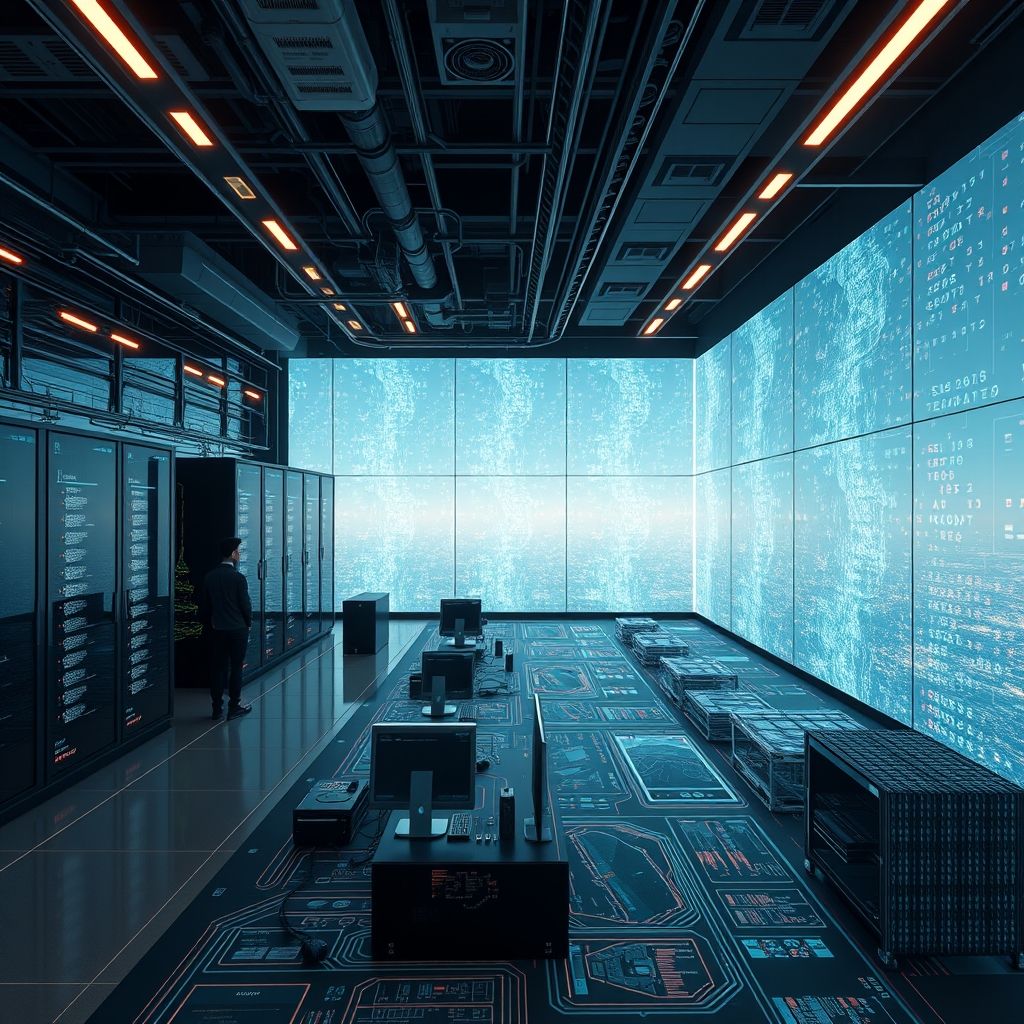
Stony Brook’s Digital Twin Studio: A New Frontier for Grid Research and Resilience
Stony Brook University is launching a Digital Twin Studio to accelerate grid research, resilience planning, and operational intelligence for utilities — blending physics-based models, AI, IoT sensing, and edge computing to modernize critical infrastructure monitoring and predictive maintenance.
Introduction
Stony Brook University's announcement of a dedicated Digital Twin Studio for power grid research marks a pragmatic step toward making grids smarter, more resilient and more manageable. As utilities face increasingly complex risks — extreme weather, distributed energy resources, cyber threats and asset aging — a purpose-built environment for building, testing and validating digital twins becomes a strategic asset. This initiative is not just academic: it promises direct operational value for owners and operators of critical infrastructure.
What Happened
The university has established a Digital Twin Studio aimed at advancing grid research and resilience. The studio will integrate high-fidelity simulation tools, real-world telemetry, hardware-in-the-loop testing, and advanced analytics to emulate distribution and transmission systems under diverse scenarios. The facility is designed to support collaborations among researchers, utilities, vendors and regulators to prototype new control strategies, sensor deployments and AI-driven inspection workflows in a controlled yet realistic setting.
Why This Matters for Critical Infrastructure Owners and Operators
Utilities and infrastructure operators can no longer rely solely on traditional monitoring and manual inspection. Digital twins create a continuous, virtual mirror of physical assets and system states — enabling near real-time situational awareness, accelerated decision-making, and better contingency planning. For owners and operators, the Studio’s work translates to fewer unplanned outages, more efficient maintenance spend, and improved compliance evidence for regulators and insurers.
Operational Benefits
By combining sensor data with simulation, operators can run “what-if” scenarios to anticipate cascading failures, test restoration strategies and validate microgrid islanding procedures without risking service. The Studio’s capacity for hardware-in-the-loop and field-device emulation lets teams verify control logic and protection settings before deploying them into production SCADA environments.
Asset Management and Prioritization
Digital twins enable risk-scored asset inventories: algorithmic prioritization of poles, transformers, breakers and lines based on condition, criticality and failure consequence. That helps utilities move from calendar-based maintenance to risk-based, predictive strategies that allocate limited crews and capital where they most reduce systemic risk.
How Digital Twins, AI and Sensing Work Together
At the core of the Studio is a layered architecture: physics-informed models capture electrical and thermal behavior; IoT sensors and telemetry provide the live state; AI and machine learning extract patterns and predict failures; and edge computing handles low-latency inference and local control loops.
IoT Sensors and Data Fusion
Reliable digital twins depend on quality data. Strategic placement of IoT sensors — current and voltage monitors, thermal cameras, vibration sensors and weather stations — feeds the virtual model. Data fusion combines SCADA, AMI (smart meter) streams and drone-, truck- or satellite-derived imagery into a coherent state estimate. The Studio’s testbeds let engineers evaluate sensor types, sampling rates and communication topologies to balance fidelity and cost.
AI, Computer Vision and Predictive Maintenance
Computer vision models trained in the Studio can automatically detect corrosion, vegetation encroachment, insulator defects and conductor anomalies from aerial or ground imagery. Coupled with physics-based prognostics, AI yields probabilistic remaining-life estimates that underpin predictive maintenance schedules. This hybrid approach (physics + data-driven) reduces false positives and improves trustworthiness for operational use.
Edge AI for Resilience
Latency and connectivity constraints in the field mean some analytics must run at the edge. The Studio enables testing of Edge AI workflows that perform local anomaly detection, transient event classification and autonomous protection actions when central systems are unreachable. Validating these behaviors in a sandboxed environment mitigates operational risk before field rollouts.
Practical Engineering and Operational Insights
Building an effective digital twin program requires careful attention to integration, validation, and lifecycle management. Some practical takeaways from what the Studio aims to demonstrate include:
Model Validation and Uncertainty Quantification
Engineers must routinely validate twin outputs against field measurements and quantify uncertainty. Sensitivity analysis helps identify which sensors most reduce model error, guiding cost-effective sensing strategies. The Studio’s emulation of measurement noise and failure modes aids in robust model calibration.
Interoperability and Standards
Interfacing digital twins with existing SCADA, OMS and asset management systems requires standards-based data models (e.g., CIM, IEC 61850) and secure APIs. The Studio provides a place to prototype these integrations and demonstrate compliance with operational protocols and cyber requirements.
Cybersecurity and Governance
Digital twins expand the attack surface because they ingest operational data and often connect to control systems. Strong governance — role-based access, encryption, anomaly detection for data integrity and rigorous change management — must be integral to deployments. The Studio environment allows red-team exercises and resilience testing under adversarial scenarios.
Future Industry Implications
The establishment of a Digital Twin Studio signals that digital replica technologies are transitioning from experimental to mission-critical. Expected industry shifts include:
Standardized Twin Frameworks and Twin-as-a-Service
Utilities will increasingly adopt standardized twin frameworks and procure Twin-as-a-Service from vendors offering validated models, continuous updates and federation across regions. This lowers the barrier for smaller utilities to benefit from twin capabilities without large upfront development costs.
Federated Learning and Privacy-Preserving Analytics
As multiple utilities collaborate, federated learning will enable cross-organization model improvements without sharing raw operational data, preserving privacy while improving anomaly detection and failure forecasting models.
Workforce Transformation
Engineers and field crews will need new skills in data interpretation, AI oversight and remote operations. The Studio can act as a training ground for upskilling operators on how to interpret twin outputs and integrate them into routine workflows.
Conclusion
Stony Brook’s Digital Twin Studio is a timely infrastructure for advancing grid resilience and operational intelligence. By coupling physics-based simulation with AI, computer vision, IoT sensing and edge analytics, the Studio provides a practical environment to reduce uncertainty, validate innovations, and de-risk deployments. For critical infrastructure owners and operators, the lessons and validated approaches emerging from such a facility will accelerate the transition to predictive, data-driven asset management and more resilient grid operations. The imperative is clear: pilot digital twins now, validate them rigorously, and scale the solutions that demonstrably reduce outage risk and maintenance cost while strengthening public safety and system reliability.